Key Takeaways
- Contrast injectors are mission-critical devices for CT and MRI workflows, so neglecting maintenance directly threatens image quality, patient safety, and department throughput.
- A tiered preventative maintenance schedule with daily, weekly, monthly, and annual tasks is the most effective way to keep injectors fully operational and compliant.
- Consistent preventative maintenance can extend contrast injector lifespan from 5–7 years to as long as 20 years, delaying expensive capital replacement.
- Clearly dividing responsibilities between technologists, biomedical engineers, and certified service partners prevents gaps in care and improves uptime.
- Tailoring maintenance schedules to injector age, usage volume, and environmental conditions helps hospitals optimize performance and control lifecycle costs.
Preventative maintenance for contrast injectors is not just a “nice to have”—it is foundational to safe, efficient, and financially sustainable imaging operations. These devices sit at the heart of CT and MRI workflows, delivering precise contrast volumes at tightly controlled flow rates so radiologists can trust what they see on every scan. When injectors drift out of specification or fail unexpectedly, the impact is immediate: compromised image quality, delayed diagnoses, frustrated clinicians, and costly downtime.
By building structured maintenance schedules—spanning daily cleaning, weekly inspections, monthly checks, and annual professional service—hospital equipment managers can turn reactive firefighting into proactive asset management. The result is longer equipment life, fewer emergency repairs, better compliance, and a far more predictable budget. This article breaks down how preventative maintenance schedules work, what they should include, and how thoughtful planning can extend contrast injector lifespan while protecting both patients and hospital finances.
What Are Contrast Injectors and Why Does Preventive Maintenance Matter?
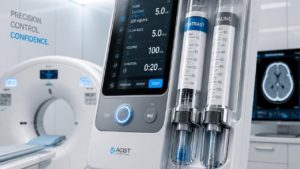
Contrast injectors deliver precise volumes of contrast media at controlled flow rates during CT and MRI scans. These devices are critical infrastructure in hospital imaging maintenance programs, directly impacting image quality, patient safety, and operational efficiency. Effective contrast injector maintenance schedules protect both clinical outcomes and capital investments.
How Do CT and MRI Contrast Injectors Support Modern Diagnostic Imaging Workflows?
CT and MRI contrast injectors enable precise, automated contrast delivery that manual injection cannot match. Modern systems incorporate advanced air pressure and fluid monitoring to enhance patient and user safety throughout each procedure.
Power injection is superior for enhancing body CT imaging. The CT motion™ injector utilizes dual air detection technology with monitors in both the pump and patient tubing, automatically halting injections if air bubbles are detected. The MEDRAD Centargo injector integrates three inlet air sensors to detect empty bottles or bags and one outlet air sensor to identify air before it reaches the patient line. These safety systems reduce operator burden while protecting patients from injection-related complications.
What Safety and Image-Quality Risks Arise When Injector Maintenance Is Neglected?
Neglected maintenance directly compromises both diagnostic accuracy and patient safety. Inconsistent flow rates compromise imaging quality and diagnostic accuracy. Pressure fluctuations from clogs, leaks, improper syringe loading, or injector head problems directly impact image quality and patient safety.
Clinical risks are measurable and significant. Extravasation occurs in 0.1% to 1.2% of power injections. Venous air embolism associated with CT contrast injection ranges from 7% to 23%; while often asymptomatic, large volumes can be fatal. Cross-contamination risks exist in multi-patient systems due to blood backflow. Operationally, downtime from equipment failures results in multiple canceled scans daily. Material buildup compromises seals and affects system responsiveness, creating cascading failures that preventative maintenance planning prevents.
Why Is Injector Lifespan Planning a Strategic Issue for Hospital Equipment Managers?
Injector lifespan planning directly impacts capital budgets and operational continuity. The typical useful service life of a contrast media injector without consistent preventative maintenance is 5 to 7 years. With proper maintenance, these devices remain operational for up to 20 years—a 186-300% lifespan increase.
Financial stakes are substantial. Equipment replacement exceeds $30,000 per unit. Emergency repair bills range from $1,500 to $5,000 per incident. Neglecting proper injector care accelerates costly equipment replacement and increases staff hours dedicated to troubleshooting. Equipment performance optimization through structured injector service timelines delivers measurable ROI by extending asset life and preventing unplanned capital expenditures.
How Does Preventive Maintenance Extend Contrast Injector Lifespan and Reduce Lifecycle Costs?
Preventive maintenance planning transforms injectors from 5-7 year assets into 20-year investments. Strategic contrast injector maintenance schedules intercept failure modes before they cascade into expensive repairs, unplanned downtime, and premature replacement. The financial case is clear: structured maintenance costs less than reactive repairs while extending equipment life threefold.
Which Common Injector Failure Modes Can Be Prevented With Routine Maintenance?
Most injector failures stem from preventable causes that routine maintenance eliminates. Inconsistent flow rates often result from air bubbles in tubing and syringes that proper purging procedures prevent. Pressure fluctuations arise from clogs, leaks, improper syringe loading, or injector head problems—all detectable through regular inspection.
Syringe connection problems lead to leaks, air aspiration, or inaccurate contrast delivery when syringes are not correctly aligned and securely attached. Electrical malfunctions from faulty wiring, damaged connectors, or power supply issues result in system failures or erratic behavior. Regular cleaning prevents material buildup that compromises seals or affects responsiveness. Each failure mode has a maintenance countermeasure that costs far less than the repair it prevents.
How Does Preventive Maintenance Lower Emergency Repair Bills and Unplanned Downtime?
Emergency repairs cost $1,500 to $5,000 per incident—expenses that preventative maintenance planning eliminates. Facilities with service contracts experience 28% less downtime during emergency service events compared to those without contracts. Remote support resolves 29% of customer calls within 30 minutes or less, reducing equipment downtime without dispatch costs.
Over five years, preventative maintenance costs remain stable at $15,000 total, while reactive maintenance escalates to $19,500 or more due to increasing repair frequency. Poor maintenance increases staff hours dedicated to troubleshooting, compounding operational costs. Equipment performance optimization through scheduled maintenance replaces unpredictable emergency spending with predictable, lower-cost interventions.
How Does Extending Injector Lifespan Delay Capital Replacement and Improve ROI?
Equipment replacement exceeds $30,000 per unit—a capital expense that proper maintenance delays by a decade or more. With structured injector service timelines, injectors operate for up to 20 years compared to 5-7 years without consistent preventative maintenance.
Service contract options fit different budgets. Annual OEM service contracts cost approximately $3,000 per model. Third-party service contracts average approximately $1,500 annually. In-house training for service engineers costs as low as $1,300 per model, offering substantial long-term savings. An extended equipment lifespan provides substantial ROI by delaying or avoiding replacement costs entirely. Hospital imaging maintenance programs that prioritize preventative maintenance planning consistently outperform reactive approaches on both uptime and total cost of ownership.
What Should Hospitals Include in a Preventive Maintenance Schedule to Ensure Contrast Injectors Remain Fully Operational and Compliant?
Effective contrast injector maintenance schedules divide responsibilities across daily, weekly, monthly, and annual intervals. This tiered approach distributes workload efficiently while ensuring comprehensive coverage of all critical systems. Clear role assignments prevent gaps and overlaps, optimizing both equipment performance and staff time.
Which Daily and Pre-Use Checks Should Technologists Perform at the Scanner?
Daily maintenance takes 10-15 minutes and forms the foundation of equipment performance optimization. Technologists clean the injector exterior, touchscreens, and any areas exposed to fluid or contrast residue after every use. This prevents material accumulation that degrades system responsiveness over time.
Technologists inspect connections and tubing for wear, leaks, or air bubbles, as these impact injection timing or lead to adverse reactions from incorrect dosing. Before shutdown, systems are reset and default settings verified for subsequent scans to prevent operational drift or glitches. These brief checks intercept the most common failure modes before they affect patient care.
Which Weekly and Monthly Inspections Should Biomedical Engineers Own and Document?
Weekly checks take 20-30 minutes and extend beyond surface-level inspection. Biomedical engineers visually inspect the injector head, test the touchscreen or software interface, listen for unusual motor sounds, back up system data (if applicable), and inspect tubing and accessories for cracks or dryness.
Monthly maintenance activities take 45-60 minutes and address mechanical and electrical systems. Engineers lubricate moving parts per manufacturer recommendations, check system calibration, perform full test injections using water or safe test fluid, inspect electrical cords and outlets, and review system error logs or alerts. These scheduled interventions maintain baseline performance and document trending issues before they escalate.
Which Annual Inspections, Calibrations, and Safety Tests Require Certified Service Partners?
Annual preventive maintenance is required to ensure injectors operate within manufacturer specifications. Typical annual PM takes 30 minutes to 2 hours, depending on injector model and cleaning requirements, averaging one hour. This injector service timeline addresses components inaccessible during routine maintenance.
Annual procedures include complete injector head cleaning (removing covers to verify no contrast or saline has entered internal components), operational inspection, flow rate and volume checks, plunger position verification, and pressure limit checks. Essential test equipment includes a pressure gauge reaching 2,000 PSI for various syringe types. Some models require digital timers for accurate injection duration measurements. While annual PM is mandatory, calibration is only necessary if the injector falls outside manufacturer specifications. Professional service visits ensure calibration adheres to OEM standards, protecting warranty coverage and regulatory compliance.
How Should Logs, Checklists, and Documentation Be Structured to Support Audits and Regulatory Compliance?
Detailed records, such as PM reports and inspection stickers, are essential to track maintenance history and prevent future issues. PM visits include updated inspection stickers and asset stickers that provide visual verification of service currency.
Documentation must include device recalls, field actions, or software notices. Service records document prior issues, parts replaced, and comprehensive service history. This structured approach to hospital imaging maintenance supports regulatory compliance and audit requirements while creating actionable data for fleet management decisions. Proper documentation transforms preventative maintenance planning from a compliance burden into a strategic asset.
How Should Maintenance Responsibilities Be Divided Between Technologists, Biomeds, and External Service Partners?
Clear role definition prevents maintenance gaps and optimizes resource allocation. Technologists own daily operations, biomedical engineers manage intermediate maintenance and documentation, and external partners handle advanced procedures requiring specialized tools or certifications. This division balances cost control with technical expertise across the complete injector service timeline.
What Training and Competencies Are Essential for Frontline Technologists Handling Injectors?
Regular, brief training sessions on contrast injector maintenance—20 minutes every few months—are generally sufficient for technologist competency. Service training courses cover basic injector functions, interpretation of pressure alerts and sensor errors, daily cleaning and care tips, and review of training manuals and safety procedures.
Training sessions enhance employee morale, reduce misuse and accidental damage, and prevent recurring issues. Programs culminate in a training certificate to document competency, creating verifiable evidence for regulatory audits. Minimal time investment yields measurable improvements in equipment performance optimization and operational consistency.
How Can Biomedical Teams Standardize Procedures Across Multiple Injector Models and Vendors?
Preventive maintenance involves routine checking, cleaning, and testing to prevent malfunctions. This continuous process ensures injectors remain safe, clean, and operational for every scan. PM includes testing injector functions, cleaning surfaces, checking for leaks, and inspecting key components across all models.
While PM kits are available, no parts are mandated for annual replacement. Gaskets often require regular cleaning and may need replacement if cleaning is no longer effective. Standardized contrast injector maintenance schedules apply consistent protocols across different manufacturers, reducing training burden and documentation complexity. Biomedical teams create model-specific checklists that adapt core procedures to vendor variations without reinventing the entire preventative maintenance planning framework.
When Is It Smarter to Rely on OEM or Third-Party Service Providers for Advanced PM Tasks?
Cost and warranty considerations drive the outsourcing decision. OEM service contracts cost approximately $3,000 annually per model. Third-party service contracts run approximately $1,500. Training service engineers for in-house maintenance costs as low as $1,300 per model, offering long-term savings for facilities with multiple units.
Factory-authorized service maintains the manufacturer’s warranty, while unauthorized service may void warranties. OEM parts are designed to manufacturer specifications to ensure optimal performance. Certified technicians undergo factory training with regular recertification—Guerbet requires renewal every 24 months. Using certified technicians and OEM parts ensures adherence to manufacturer guidelines for patient safety. For hospital imaging maintenance programs, the decision hinges on fleet size, internal technical capacity, and warranty value. Single-unit facilities often benefit from OEM contracts, while multi-unit departments may justify in-house capabilities or third-party partnerships.
How Can Hospitals Tailor Preventive Maintenance Schedules to Injector Age, Usage Levels, and Clinical Environment?
One-size-fits-all maintenance fails in diverse clinical environments. Effective preventative maintenance planning adapts injector service timelines to usage intensity, equipment age, and environmental stressors. Customized contrast injector maintenance schedules deliver better equipment performance optimization than rigid protocols that ignore operational context.
How Should PM Frequency Change for High-Volume, Medium-Volume, and Low-Volume Imaging Sites?
Preventive maintenance on contrast injectors is performed annually as a baseline requirement across all volume levels. A comprehensive maintenance strategy encompasses daily cleaning, weekly inspections, monthly reviews, and annual professional service regardless of scan volume. This consistent framework ensures devices remain operational for up to 20 years with proper maintenance across all usage levels.
High-volume sites benefit from stricter adherence to daily and weekly protocols, as accelerated wear concentrates failure risk. Low-volume sites face different challenges—extended idle periods require attention to seal integrity and fluid system cleanliness. Both extremes demand the same annual professional service but different vigilance on interim checks.
How Do Injector Age, Error History, and Component Wear Influence Schedule Adjustments?
Reviewing system error logs or alerts is crucial for identifying deeper issues requiring more frequent attention. Aging injectors demand proactive component monitoring—gaskets often require regular cleaning and may need replacement if cleaning is no longer effective.
PM helps maintain a consistent flow rate for contrast delivery, reducing the likelihood of head unit replacements or syringe repairs. Regular maintenance lowers the risk of power supply failures and monitors issues that increase as units age. Comprehensive diagnostic checks during PM visits help identify issues that internal teams might overlook. Hospital imaging maintenance programs should intensify monthly inspections for units beyond 10 years or those with recurring error codes, transitioning from preventative to predictive maintenance as equipment ages.
How Do Environmental Factors Like Temperature, Humidity, and Storage Conditions Affect PM Planning?
Injectors should be stored away from extreme heat or humidity to extend equipment longevity. Equipment must be protected from direct light exposure, which degrades plastic components and seals over time.
Accessories like syringes and tubing must be kept in sealed, dust-free environments to prevent contamination and material degradation. Power cords should be free from bends or crimps to prevent electrical issues. Proper storage and handling practices contribute significantly to equipment longevity, sometimes more than operational factors. Facilities in humid climates or those with temperature-variable equipment rooms should increase inspection frequency for seals, electrical connections, and fluid system integrity. Environmental stressors accelerate degradation, requiring adjusted contrast injector maintenance schedules that reflect actual
operating conditions rather than manufacturer assumptions.
Extend Injector Life with Smart Maintenance Partnerships
Well-designed preventative maintenance schedules are one of the most powerful levers hospitals have to keep contrast injectors safe, reliable, and cost-effective over the long term. By combining disciplined daily routines, structured technical inspections, and certified annual service, you can dramatically reduce unexpected failures, safeguard patient care, and squeeze maximum value out of every injector you own.
At Spectrum Medical Imaging Co., we help you turn those schedules into reality. We work with your technologists and biomedical teams to design practical maintenance plans, perform certified inspections and calibrations, and respond quickly when critical equipment needs attention. If you’re ready to extend the lifespan of your contrast injectors, cut repair costs, and stabilize your imaging uptime, reach out to us—we’re here to support your department with the expertise, service, and reliability your patients deserve.