Contrast media selection balances diagnostic accuracy, patient safety, and resource management across medical imaging modalities. The global contrast media market reached USD 8.20 billion in 2026 and is projected to grow to USD 12.08 billion by 2031, reflecting expanding demand from cardiovascular, oncologic, and interventional applications.
Radiology clinic selection processes must account for category-specific performance characteristics, patient preference patterns, and operational constraints. A comprehensive contrast media guide integrates manufacturer specifications, safety screening protocols, pricing benchmarks, and workflow optimization strategies. This article synthesizes market data, utilization evidence, patient surveys, and clinical guidelines for the four major contrast categories: iodinated, gadolinium-based, microbubble, and barium agents.
Key Takeaways
- Iodinated contrast media dominate with 55% market share in 2026, accounting for 95.6% of measured Medicare contrast volume
- Patients value cancer detection sensitivity 2.3 times more than mild reaction risk when evaluating contrast media attributes
- Macrocyclic gadolinium agents offer greater stability than linear formulations, reducing tissue deposition risks in vulnerable patients
- Microbubble ultrasound contrast media demonstrate 10.7% CAGR growth from 2025 to 2033, driven by renal safety advantages
- Emergency departments achieved 80% contrast reduction during shortages through multimodal substitution and waste-reduction protocols
What Are the Main Types of Contrast Media Used in Radiology?
Contrast media categories differ in chemical structure, imaging modality, administration route, and clinical risk profile. Iodinated agents dominate CT and angiography, gadolinium compounds enable MRI lesion characterization, microbubble formulations enhance ultrasound perfusion imaging, and barium suspensions provide gastrointestinal visualization.
Category selection depends on the target information domain. Vascular patency requires iodinated CT angiography, soft-tissue lesion characterization favors gadolinium MRI, real-time perfusion assessment benefits from microbubble ultrasound, and enteric delineation relies on barium fluoroscopy.
What Distinguishes Iodinated Contrast Media in CT and Angiography?
Iodinated contrast media are water-soluble iodinated molecules formulated as nonionic low-osmolar or iso-osmolar compounds to reduce adverse events. These agents achieved 55% market share in 2026 and accounted for 95.6% of measured Medicare contrast volume over 2011-2024. CT abdomen/pelvis examinations contributed approximately 4.4 billion mL within the Medicare dataset.
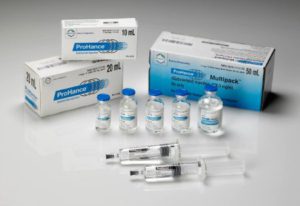
Omnipaque 300 (iohexol) by GE HealthCare is priced at USD 400.57 for 10 × 10 mL vials and USD 4,502.60 for 10 × 500 mL bottles. Clinicians must screen patients for eGFR below 30 mL/min/1.73 m², acute kidney injury, diabetes with chronic kidney disease, dehydration, and concurrent nephrotoxic medications.
How Do Gadolinium-Based Agents Function in MRI Imaging?
Gadolinium-based contrast agents are chelated gadolinium complexes that enhance T1-weighted signal intensity in magnetic resonance imaging (MRI) of vascularized tissues. Macrocyclic agents feature ring-like structures offering greater stability than linear chain-like configurations. The gadolinium segment reached USD 1.66 billion in 2025.
Gadavist (gadobutrol) by Bayer exemplifies a macrocyclic GBCA classified as Group II by the American College of Radiology. Macrocyclic formulations demonstrate lower propensity for gadolinium dissociation and tissue deposition. Physicians must assess renal dysfunction, prior GBCA reaction history, pregnancy status, and cumulative exposure when determining the use of contrast media, particularly in patients with eGFR below 30 mL/min/1.73 m².
When Are Microbubble Ultrasound Contrast Media Preferred?
Microbubble contrast agents are gas-filled microbubbles with phospholipid, albumin, or polymer shells, enhancing ultrasound imaging backscatter for perfusion assessment through ultrasound enhancement. Microbubble ultrasound agents demonstrate 10.7% CAGR from 2025 to 2033, driven by renal safety advantages and expanding liver imaging applications.
Despite 65.4% of surveyed radiologists reporting awareness of CEUS benefits, 54.8% indicated CEUS was not performed at their institution. Low mechanical index settings, typically below 0.3, preserve microbubble integrity. Facilities considering CEUS adoption must address operator training, protocol standardization, and equipment compatibility.
How Do Market Trends and Utilization Patterns Influence Contrast Media Choices?
The global contrast media market, valued at USD 8.20 billion in 2026, is projected to reach USD 12.08 billion by 2031, implying a 7.9% compound annual growth rate. Asia Pacific, achieving the fastest growth at 9.5% CAGR, reflects new imaging capacity deployment in China, India, and developing markets.
Medicare claims data covering 169.3 million contrast-enhanced examinations across 82 CPT codes show iodinated agents delivered 12.9 billion mL, underscoring CT’s dominance in older-adult emergency and inpatient imaging.
What Are the Global Market Shares and Growth Forecasts for Contrast Media Categories?
The global contrast media market, valued at USD 8.20 billion in 2026, is projected to reach USD 12.08 billion by 2031 with a 7.9% CAGR. Asia Pacific represents the fastest-growing region at 9.5% CAGR.
Category-level revenue shows gadolinium-based agents at USD 1.66 billion, microbubble formulations at USD 624.9 million, and barium agents at USD 299.0 million in 2025. Iodinated agents account for approximately 61.7% of total contrast revenue, gadolinium-based agents 21.7%, microbubble agents 8.2%, and barium agents 3.9%.
How Do Clinician and Patient Preferences Affect Contrast Media Adoption?
In a national radiology practice survey, 93% of healthcare professionals ranked patient safety as critical, 92% prioritized image quality, and 87% emphasized supply availability. These rankings demonstrate that contrast agent decision tree frameworks must integrate safety screening, equipment compatibility, and vendor reliability.
Patient preference evidence reveals different emphasis. In a four-center breast MRI conjoint study, 44.3% of participants ranked cancer detection sensitivity first, significantly exceeding mild allergic-like reaction risk at 19.5%, severe reaction risk at 17.0%, and gadolinium retention at 11.6%. Cancer detection sensitivity was valued approximately 2.3 times higher than the mild reaction risk.
What Demographic and Regional Factors Impact Contrast Media Utilization?
Age-stratified utilization shows annual per-capita imaging expenditure rises from USD 81.0 PPP in ages 0-11 to USD 208.6 PPP in adults aged 60 and older. Rural areas demonstrate higher per-capita expenditure at USD 229.7 PPP versus urban areas at USD 207.6 PPP in older adults.
The Medicare study covered 169.3 million contrast-enhanced examinations across 82 CPT codes. Total iodinated contrast volume reached 12.9 billion mL, with CT abdomen/pelvis contributing approximately 4.4 billion mL.
What Are the Key Safety and Efficacy Priorities for Patients and Clinicians?
Safety considerations vary by contrast category, requiring distinct screening protocols. Iodinated contrast necessitates renal function assessment focusing on eGFR, acute kidney injury status, diabetes with chronic kidney disease, hydration adequacy, and nephrotoxic co-medication exposure. Gadolinium-based agents require evaluation of renal dysfunction, prior GBCA reaction history, pregnancy status, and cumulative exposure.
Low-income patients assigned 14.9% importance to out-of-pocket cost versus 5.7% for high-income cohorts. Among surveyed radiologists, 55% expressed gadolinium-agent availability concerns, rising to 75% in small hospitals versus 35% in larger institutions.
How Do Patients Rank Risks Versus Diagnostic Benefits?
Patient preference data from the breast MRI conjoint study shows 19.5% ranked mild allergic-like reaction risk among top concerns. Severe allergic-like reaction risk received 17.0% priority, gadolinium retention 11.6%, and out-of-pocket cost only 7.5%. Cancer detection sensitivity dominated at 44.3%.
Low-income patients assigned 14.9% importance to cost versus 5.7% for high-income patients, and slightly higher importance to gadolinium retention at 15.7% versus 10.1%. Despite these differences, cancer detection sensitivity remained the top-ranked attribute across all income brackets.
What Clinical Considerations Drive Safety Screenings for Contrast Use?
Iodinated contrast safety protocols require screening for eGFR below 30 mL/min/1.73 m², acute kidney injury, comorbid diabetes with chronic kidney disease, hydration status, advanced age, and concurrent nephrotoxic medications. Acute kidney injury represents a significant risk factor independent of baseline eGFR.
Gadolinium-based contrast administration screening focuses on renal dysfunction, prior GBCA reaction history, pregnancy status, and cumulative exposure frequency. Macrocyclic formulations are preferred to minimize gadolinium dissociation risk. Renal-risk management protocols for iodine-based and gadolinium compounds emphasize using the lowest effective contrast volume, providing hydration, avoiding routine NSAIDs, and exercising caution with metformin.
How Does Cost and Availability Influence Contrast Media Selection?
Cost sensitivity varies by patient income level and institutional purchasing power. Low-income patients assigned 14.9% importance to out-of-pocket cost compared with 5.7% for high-income patients.
Small hospitals reported availability concerns at 75% versus 35% in larger institutions. Omnipaque 300 pricing ranges from USD 400.57 for 10 × 10 mL vials to USD 4,502.60 for 10 × 500 mL bottles, demonstrating the importance of volume purchasing and evaluating reliable contrast media suppliers.
How Do Clinicians Decide Which Contrast Agent to Use for Different Imaging Modalities?
Clinical decision frameworks prioritize matching contrast agent properties to diagnostic requirements. The American College of Radiology Manual on Contrast Media asks whether the indication is valid, whether expected benefits outweigh risks, and whether alternative tests could provide equivalent information.
Modality-specific selection criteria diverge substantially. CT and angiography workflows emphasize renal safety screening and iodine delivery optimization, MRI protocols focus on gadolinium formulation stability and relaxivity, ultrasound applications prioritize microbubble acoustic properties and mechanical index settings, and GI studies balance luminal visualization against aspiration risk.
What Is the Physician Decision Framework for CT and Angiography Contrast Use?
Physician preferences for CT parenchymal imaging show 70.0% favoring lean-body-weight dosing protocols. For CT angiography, preferences fragment: 35.2% prefer lean body weight, 26.9% favor iodine delivery rate optimization, and 25.6% use fixed-amount protocols.
The first clinical question asks whether contrast enhancement will materially change diagnosis or management. If negative, a non-contrast CT scan or alternative modalities should be considered. For emergency imaging where contrast is indicated, physicians must determine optimal timing, injection rate, and scan delay to capture diagnostic information while minimizing total contrast volume and radiation exposure.
What Factors Determine MRI Contrast Agent Selection?
Magnetic resonance (MRI) contrast selection hinges on distinguishing macrocyclic versus linear gadolinium structures. Macrocyclic agents demonstrate superior thermodynamic and kinetic stability, reducing gadolinium dissociation likelihood. Nephrogenic systemic fibrosis risk in patients with severe renal dysfunction represents a critical safety concern when eGFR falls below 30 mL/min/1.73 m².
Gadolinium retention in the brain, bone, and other tissues has emerged as a consideration even in patients with normal renal function following repeated GBCA administrations. Facilities implementing strategies to improve MRI imaging outcomes increasingly adopt ultra-fast MRI protocols of 20 minutes or less.
When Is Contrast-Enhanced Ultrasound or Oral/Enteric Contrast Preferred?
Contrast-enhanced ultrasound selection requires considering operator expertise and cardiopulmonary context since microbubble agents undergo partial pulmonary elimination. CEUS demonstrates operator dependence because real-time image optimization and dynamic interpretation require specialized training. Weaker whole-body coverage limits CEUS application primarily to focal liver lesions, renal masses, and vascular flow assessment.
Barium contrast use necessitates evaluating aspiration risk, allergy history, and volume tolerance. Poor acoustic windows and obesity pose significant CEUS limitations because ultrasound penetration decreases with increasing tissue depth and body mass index.
What Are the Practical Differences in Formulation, Advantages, and Limitations Among Contrast Media?
Formulation differences extend beyond chemical composition to osmolality, viscosity, iodine concentration, stability characteristics, and route-specific optimization. Iodinated agents vary between high-osmolar, low-osmolar, and iso-osmolar formulations, with modern practice favoring nonionic low-osmolar and iso-osmolar compounds. Gadolinium-based agents differ as macrocyclic versus linear chelates and functionally as extracellular-space agents, hepatocyte-specific compounds, or blood-pool formulations.
Iodinated contrast offers the broadest modality compatibility but requires careful renal-risk management and protocols for managing allergic reactions. Gadolinium agents enable superior soft-tissue characterization but carry tissue retention concerns and premium pricing. Microbubble formulations provide renal safety and real-time perfusion imaging but suffer from limited anatomic coverage, while barium suspensions deliver cost-effective gastrointestinal visualization constrained to enteric applications.
How Do Iodinated Contrast Agents Vary by Formulation and Clinical Use?
Best practices for iodinated contrast emphasize minimizing the total volume to the lowest amount necessary. Hydration protocols should be implemented when appropriate, particularly in patients with borderline renal function. Routine NSAID administration is avoided because these medications increase nephrotoxicity risk when combined with iodinated contrast.
Special caution applies to metformin, which should be withheld temporarily except in emergencies where diagnostic delays pose greater harm. Intra-arterial administration increases renal exposure compared to intravenous routes. Imaging contrast criteria for proper storage and handling include maintaining temperature stability, protecting from light exposure, and monitoring expiration dates.
What Are the Structural and Performance Differences in Gadolinium Agents?
Macrocyclic gadolinium formulations demonstrate a ring-like molecular architecture that constrains the gadolinium ion more tightly than linear chain-like structures. This translates to superior stability, reducing gadolinium dissociation probability. Linear agents remain cost-effective for many applications, but macrocyclic compounds are increasingly preferred when cumulative exposure or renal vulnerability creates elevated retention risk.
Relaxivity characteristics determine how efficiently gadolinium compounds enhance the T1-weighted MRI signal per unit concentration. Higher relaxivity formulations may achieve equivalent image quality at lower doses. Field strength at 3.0 Tesla versus 1.5 Tesla influences relaxivity performance and optimal dosing.
What Formulations and Clinical Roles Define Microbubble and Barium-Based Agents?
Barium-based contrast agents consist of barium sulfate suspensions for gastrointestinal imaging, including fluoroscopy, swallow studies, and CT enterography. Lumason (sulfur hexafluoride lipid-type A microspheres) by Bracco received FDA approval for liver lesion characterization in adult and pediatric patients. Readi-Cat 2 barium sulfate suspension functions as a standard CT bowel preparation agent priced at approximately USD 81.00 per 450 mL bottle.
The barium segment reached USD 299.0 million in 2025, concentrated in GI radiology and fluoroscopy. Microbubble formulations achieved USD 624.9 million in 2025 despite limited institutional adoption, reflecting premium per-dose pricing and concentrated use in hepatic imaging.
How Do Workflow, Supply, and Emergency Situations Affect Contrast Media Selection?
Supply-chain disruptions force radiology departments to implement rapid operational adaptations. During the 2022 iodinated contrast shortage, facilities implemented conservation strategies including modality substitution, non-contrast protocol expansion, and waste-reduction initiatives. Emergency and inpatient populations accounted for 80% of daily contrast volume in the safety-net hospital case study.
Hospitals achieved 80% reduction in contrast use during shortages by redirecting stable patients to MRI/MRA, ultrasound, V/Q scanning, and tagged RBC studies while preserving iodinated agents for trauma, acute stroke, pulmonary embolism, and critical interventional procedures. Multi-valve tubing innovations reduced waste by 75%, enabling one 200 mL bottle to serve three patients.
What Strategies Optimize Contrast Use During Shortages or High-Throughput Scenarios?
Emergency and inpatient imaging accounted for approximately 80% of daily contrast volume in the safety-net hospital case study. The institution achieved 80% reduction by systematically reviewing indication appropriateness, expanding non-contrast protocols, and implementing modality substitution pathways. Multi-valve tubing systems enabled the sharing of 200 mL contrast bottles across three patients, reducing single-use waste by approximately 75%.
Equipment modifications and protocol revisions created an immediate inventory extension. Cardiology departments adopted multi-valve connectors for catheterization procedures. Radiology departments expanded non-contrast CT protocols for follow-up examinations, reserving limited iodinated inventory for new diagnostic questions.
How Do Institutions Implement Multimodal Contrast Stewardship?
Multimodal stewardship programs integrate CT, MRI, ultrasound, and nuclear medicine capabilities to maintain diagnostic throughput. Facilities redirect appropriate patients from iodinated CT to gadolinium MRI/MRA when vascular anatomy remains the clinical question. Ultrasound with microbubble enhancement substitutes for contrast CT in hepatic lesion characterization when renal function precludes iodinated administration.
Nuclear medicine alternatives include V/Q scanning for pulmonary embolism and tagged RBC studies for gastrointestinal bleeding localization. These substitution pathways require advanced protocol development, inter-departmental coordination, and referring physician education.
What Role Does Modality Substitution Play in Operational Resilience?
Carbon dioxide angiography serves as an iodinated contrast alternative for patients with severe renal disease or documented iodinated contrast allergy during interventional procedures. Tagged RBC nuclear medicine studies function as a substitute method for gastrointestinal bleeding localization when CT angiography would consume scarce iodinated inventory.
Ventilation-perfusion scanning provides an alternative to contrast CT pulmonary angiography for pulmonary embolism diagnosis, particularly valuable during iodinated contrast shortages. Ultra-fast MRI protocols of 20 minutes or less enable stroke and neuroimaging substitution for non-contrast head CT in selected patients.
What Clinical Contexts Determine the Best Modality-Specific Contrast Choice?
Clinical indication specificity determines whether contrast enhancement adds diagnostic value in radiological imaging. Vascular occlusion, organ perfusion, lesion characterization, inflammation detection, and tumor staging represent classic contrast-dependent indications. Conversely, fracture assessment, urolithiasis, pulmonary nodule detection, and many follow-up examinations achieve diagnostic objectives without contrast.
Interventional radiology captured 40.0% market share in 2026 as the largest application segment, driven by cardiovascular procedures. Cardiovascular indications dominated with 48.0% revenue share, reflecting intensive iodinated contrast consumption in cardiac computed tomography, angiography, percutaneous coronary intervention, and electrophysiology procedures.
When Is MRI Contrast Essential Versus Non-Contrast Options?
MRI contrast becomes essential when native tissue contrast proves insufficient for lesion detection or characterization. Brain metastases, inflammatory demyelination, blood-brain barrier disruption, vascular malformations, and hepatobiliary lesions frequently require gadolinium enhancement. Non-contrast MRI suffices for many musculoskeletal, spinal degenerative, and basic neuroanatomic applications.
Macrocyclic formulation preference increases in patients with renal dysfunction, prior gadolinium exposure, or anticipated serial imaging. Linear agents remain appropriate for routine applications in patients with normal renal function.
How Is Contrast Chosen for Emergency and Interventional Radiology?
Interventional radiology represents the largest application segment with 40.0% market share in 2026. Cardiovascular indications dominate with 48.0% revenue share, driven by coronary angiography, peripheral vascular intervention, and structural heart procedures. Emergency imaging prioritizes rapid acquisition protocols, favoring CT over MRI for most acute presentations.
When proven solutions exist to overcome contrast crises, facilities can maintain emergency imaging capacity by implementing triage protocols that reserve contrast for the highest-acuity cases. Interventional radiology departments require a robust iodinated inventory because vascular procedures cannot easily substitute alternative modalities.
What Are the Considerations for Ultrasound and Gastrointestinal Contrast Imaging?
Ultrasound contrast protocols require low mechanical index settings below 0.3 to preserve microbubble structural integrity. Higher acoustic power destroys microbubbles prematurely, reducing enhancement duration. Operator training determines CEUS diagnostic quality because real-time image optimization requires experience with contrast kinetics.
Barium contrast carries aspiration risk that precludes use in patients with dysphagia, altered consciousness, or compromised airway protection. Water-soluble iodinated oral contrast substitutes for barium when aspiration risk exists or when GI perforation is suspected.
Integrating Clinical Indication, Patient Safety, and Operational Factors in Contrast Media Selection for Radiology Clinics
Effective contrast media selection integrates clinical indication, patient-specific risk factors, modality capabilities, and operational constraints into a systematic decision framework. The evidence demonstrates that diagnostic efficacy and patient safety represent coequal priorities, with optimal decisions balancing detection sensitivity against adverse event risk through careful agent selection and dose optimization.
Radiology departments achieve best outcomes when they implement standardized protocols while preserving clinical flexibility for complex cases. Category-specific expertise matters: understanding osmolality differences among iodinated formulations, structural stability variations among gadolinium agents, acoustic properties of microbubble shells, and concentration options for barium suspensions enables evidence-based clinical contrast choice that optimizes diagnostic yield while minimizing risk and cost. For organizations seeking comprehensive support, Spectrum Medical Imaging Co. brings 30+ years of imaging industry experience and prime dealer relationships with leading manufacturers to help facilities implement reliable contrast procurement strategies aligned with imaging contrast criteria priorities.
Implementing a comprehensive contrast material selection strategy requires partnering with suppliers who understand both clinical requirements and supply-chain dynamics. If your facility needs expert guidance on optimizing contrast media procurement, inventory management, and emergency preparedness protocols, explore Spectrum Medical Imaging Co.’s imaging solutions and services to build a resilient contrast program that supports your diagnostic imaging mission.
Get Reliable Contrast Media Supply and Expert Support for Your Facility
Spectrum Medical Imaging Co. has supported hospitals, imaging centers, and radiology clinics across the West Coast for over 30 years. As a prime dealer for Guerbet, Bayer, Bracco, Fresenius-Kabi, and GE HealthCare, we deliver iodinated agents, gadolinium-based contrast media, ultrasound contrast agents, and barium products with 24–48 hour shipping nationwide. Whether your team is managing routine contrast administration protocols, preparing for supply disruptions, or optimizing your contrast material inventory, our team provides the pricing, availability, and technical guidance to keep your operations running without interruption. Contact Spectrum Medical Imaging Co. to request a quote, compare pricing, or speak with our contrast media specialists today.