Key Takeaways
- Imaging equipment replacement cycles should be planned around total cost of ownership, not just acquisition price.
- A four-phase equipment lifecycle — acquisition, operation, maintenance, replacement — gives administrators a clear framework for budgeting.
- Core modalities such as digital radiography, CT, MRI, contrast injectors, and PACS each carry different replacement timelines and service profiles.
- Imaging center planning goes beyond equipment purchases to cover staffing, patient demand, regulatory requirements, and facility layout.
- Working with an experienced medical equipment supplier reduces procurement risk and supports better equipment lifecycle decisions.
How to budget for imaging equipment replacement cycles is one of the most consequential questions imaging center administrators face in 2026. Medical imaging equipment is a long-cycle capital investment: an MRI scanner may serve a center for 7–10 years, while X-ray systems can run even longer with proper service. Underestimating what replacement equipment, preventative maintenance, and supply costs will look like across that horizon can squeeze margins, delay clinical upgrades, and disrupt patient care. A strong budget plan starts with two ideas — total cost of ownership and a clear equipment lifecycle framework — and works outward from there.
What follows is a 2026 budget-planning guide for growing imaging practices. The first section breaks down what to budget for by modality. The second section walks through the four-phase equipment lifecycle. From there, we cover imaging center planning beyond equipment, how to weigh upfront cost against long-term value, the trends shaping 2026 capital planning, and what to look for in a supplier partnership. For facilities working with Spectrum Medical Imaging Co., the goal is to align procurement decisions with real clinical demand and lifecycle costs — not the loudest sales pitch.
How to budget for imaging equipment replacement cycles by modality
Different modalities age differently. CT systems and MRI machines carry the heaviest capital tags but tend to have predictable 7–10 year service windows. X-ray systems, contrast injectors, and detector components run on shorter consumable and refurbished-parts cycles. PACS and IT infrastructure require continuous investment rather than periodic replacement. Imaging administrators should map each category separately when building a 2026 budget so that no single modality crowds out the others.
Digital radiography equipment
For most practices, upgrading or expanding digital radiography equipment is the highest-value modality investment heading into 2026. Compared with older CR or film-based systems, DR offers faster workflow, lower radiation exposure, and better image quality. In busy centers, DR technology shortens exam times and improves patient throughput. Administrators budgeting for replacement cycles should include detectors, workstations, software support, and ongoing IT costs. Facilities adding or replacing panels can review compatible options through Spectrum’s digital radiography equipment supplier catalog, which includes Vieworks panels and other current detector systems.
CT and MRI systems
CT and MRI are the largest capital line items in most imaging budgets, but they also anchor advanced diagnostic accuracy. A modern CT scanner brings faster scan times and lower radiation exposure than earlier multi-slice generations. An MRI scanner continues to expand its role in neurology, cardiology, and musculoskeletal imaging. Budget planning for these modalities should factor in throughput, patient comfort, long-term service agreements, magnet maintenance, and — for MRI specifically — cryogenic system support and magnetic field homogeneity calibration. Contrast workflows depend on reliable injector hardware and consumables; facilities can review compatible CT injectors, syringes, and tubing to keep contrast-enhanced studies running smoothly.
Contrast injectors and accessories
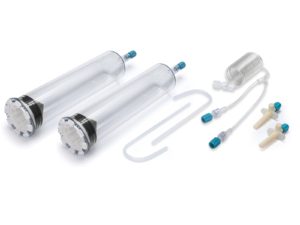
Contrast injectors are essential to delivering consistent results in both CT and MRI workflows. Practices must budget for the injectors themselves plus the steady consumable line — syringes, tubing, low-pressure connectors — and ongoing service. Replacement parts and preventive maintenance program coverage help keep injector uptime stable. Spectrum supplies CT and MRI injector systems and consumables from Guerbet, Bayer Medrad, and Bracco, with full-service maintenance available on Optistar, Optivantage, Medrad, and Bracco platforms.
PACS and IT infrastructure
Beyond physical imaging devices, PACS and storage systems are central to workflow efficiency. Budgeting for secure, compliant archiving of diagnostic images supports smooth operations, addresses cybersecurity risks, and meets Joint Commission standards and FDA regulations. PACS, HIS, and RIS investments should sit on a separate capital and operating line from modality replacement, since IT infrastructure tends to evolve continuously. Facilities can review current options through Spectrum’s PACS, HIS, and RIS systems catalog.
How to budget for imaging equipment replacement cycles across the four-phase equipment lifecycle
Managing the equipment lifecycle is central to responsible budgeting. Every imaging device moves through four phases, and each phase carries its own costs:
- Acquisition: Initial purchase, installation, application training, and integration with existing IT infrastructure.
- Operation: Daily use — consumables, staffing, utilities, and software support.
- Maintenance: Preventive and corrective servicing, service contracts, calibration drift checks, and predictive maintenance to maximize uptime.
- Replacement: Upgrade options, refurbished equipment evaluation, decommissioning, and end-of-life planning.
By budgeting across the entire lifecycle rather than just the acquisition line, imaging centers reduce surprises and capture full asset value. An MRI may operate effectively for 7–10 years; X-ray systems can run longer with proper service. Capital life extension through preventive maintenance programs, refurbished parts, and disciplined lifecycle management can extend useful life and defer larger replacement-equipment outlays. Tracking each device in an asset database with reliability data and predictive insights makes equipment lifecycle decisions far more defensible than relying on age alone. Facilities can supplement in-house service capacity through partners like Spectrum’s imaging equipment repair and maintenance team.
Imaging center planning beyond equipment purchases
Strategic imaging center planning goes well beyond equipment purchases. Administrators must also account for staffing, expected patient demand, facility layout, and regulatory standards. Adding a high-throughput CT scanner without expanding tech coverage or PACS bandwidth simply moves the bottleneck. Planning across staffing schedules, room utilization, and IT capacity ensures that new investments deliver clinical value rather than create new workflow disruption.
Imaging administrators benefit from data-driven replacement planning that aligns capital purchases with patient volume forecasts, payer mix shifts, and broader healthcare technology management goals. Joint planning between clinical leadership, finance, and Healthcare Technology Management (HTM) teams keeps service input visible early — before budgets are locked.
Balancing upfront cost with long-term value
Budget discussions often focus on the upfront price tag, but true value lies in long-term performance. Factors to weigh during budget discussions include:
- Patient throughput: Faster systems support higher daily volume and revenue.
- Diagnostic accuracy: High-quality imaging improves patient outcomes and reduces repeat exams.
- Service contracts and Service Level Agreements: Reliable technical support and full-service maintenance minimize downtime.
- Compliance: Meeting radiation safety regulations, FDA regulations, and Joint Commission standards prevents costly penalties.
- Cybersecurity: Aging detector systems and unsupported software increase cybersecurity risks tied to imaging devices on the network.
The right investment balances initial cost against asset lifecycle costs across acquisition, operation, maintenance, and replacement. Refurbished equipment, refurbished parts, and predictive maintenance can stretch capital further without compromising clinical quality — especially for medical centers facing budget cuts or supply chain disruption.
Trends shaping 2026 imaging equipment budgets
Several trends will shape capital planning conversations in 2026:
- Digital-first technology: Practices are moving away from analog and CR systems toward fully digital workflows.
- AI-assisted imaging: Emerging AI tools assist with workflow optimization and image interpretation, adding software-license line items to many imaging budgets.
- Patient safety focus: Lower radiation exposure and safer contrast delivery continue to drive equipment selection.
- Regulatory compliance: Updated standards in data security, radiation protection, and medical device cybersecurity will require additional investment.
- Supply chain resiliency: Sourcing critical consumables and replacement parts from suppliers with deep inventory protects against supply chain disruption.
Staying ahead of these trends positions practices for growth and supports trust with patients and referring physicians alike.
The role of reliable supplier partnerships
Budget planning is more effective with trusted partners who offer products, expertise, and service together. Imaging centers benefit from working with a medical equipment supplier that provides:
- Broad product selection covering all major modalities and supporting consumables.
- Preventive maintenance, predictive maintenance, and 24/7 technical support.
- 24–48 hour nationwide shipping on stocked consumables to absorb supply chain shocks.
- Application training for radiology staff on new systems.
- Honest guidance on refurbished equipment and capital life extension when full replacement is not yet warranted.
A reliable supplier — or an independent service provider working alongside the OEM service organization — helps administrators build defensible budgets and reduce long-term risk. Facilities can explore Spectrum’s full services portfolio for installation, relocation, maintenance, and project management support.
Plan your imaging equipment replacement cycles with Spectrum Medical Imaging Co.
Building a 2026 budget that holds up over a full replacement cycle takes more than a spreadsheet — it takes a partner who knows the equipment, the consumables, the service economics, and the procurement landscape. Spectrum Medical Imaging Co. has supported hospitals, imaging centers, surgery centers, urgent care facilities, veterinary practices, dental offices, and private practices across the West Coast and nationwide for more than 30+ years. As prime dealers for Guerbet, Bayer, Bracco, GE HealthCare, and Fresenius-Kabi, our specialists help you source contrast media, contrast injectors, digital radiography panels, injector syringes, and Clinton exam tables with guaranteed lowest pricing on the brands we carry.
Our team handles 24–48 hour nationwide shipping on stocked consumables and provides 24/7 technical support for clinical teams that cannot afford downtime. Whether you are mapping out a multi-year replacement plan, sourcing contrast agents for a busy CT or MRI service, replacing a Vieworks DR panel, or evaluating refurbished equipment to extend capital life, we walk you through compatible options without overselling. Trust our specialists to match the right medical imaging equipment to your clinical needs and budget — and to support that equipment across its full lifecycle.
Call 800-859-6162 to speak with a specialist or visit spectrumxray.com to request a quote.
Frequently Asked Questions
1. What is the typical replacement cycle for major imaging equipment?
Replacement cycles vary by modality, usage intensity, and service quality. MRI scanners typically serve 7–10 years before major replacement; CT scanners run on a similar 7–10 year horizon. X-ray systems often last 10–15 years with disciplined preventive maintenance. Ultrasound devices and contrast injectors tend to run 5–8 years, with consumables refreshed continuously. Detector components, software platforms, and PACS infrastructure usually need updates on shorter, more frequent cycles. Aligning replacement timing with manufacturer end-of-life notifications, calibration drift trends, and reliability data — rather than chronological age alone — gives administrators a more defensible plan.
2. How is total cost of ownership calculated for imaging equipment budgets?
Total cost of ownership combines all costs an asset accrues across its full lifecycle, not just the purchase price. The major components are acquisition (system, installation, training), operation (consumables, utilities, staffing, software support), maintenance (preventive maintenance programs, service contracts, replacement parts, calibration), and end-of-life costs (decommissioning, data migration, disposal). For accurate budgeting, administrators should pull historical service data, factor in downtime exposure, and model refurbished equipment or capital life extension scenarios alongside new-purchase scenarios. The output is a clearer comparison of two seemingly different price tags.
3. When should imaging centers consider refurbished equipment instead of new?
Refurbished equipment can be a strong fit when budget cuts limit capital, when a center needs a short-term bridge before a planned replacement, or when a specific modality is approaching but not yet at end of life. Certified refurbished systems from established vendors typically carry warranties, technical support, and parts availability that are comparable to new equipment for a substantially lower upfront cost. The trade-off is a shorter expected remaining useful life. Refurbished detector systems, contrast injectors, and X-ray components are particularly common, while CT and MRI refurbishment is also a mature market — though it requires careful magnet-condition evaluation for MRI.
4. What service agreements should be in place for major imaging equipment?
At a minimum, major modalities should be covered by service contracts or Service Level Agreements (SLAs) that define response times, parts coverage, preventive maintenance frequency, and uptime guarantees. Full-service maintenance plans from the OEM or an independent service provider can include predictive maintenance using usage data, scheduled calibration, software support, and remote diagnostics. For MRI specifically, agreements should cover cryogen management and magnetic field homogeneity checks. For contrast injectors, SLAs should include pump calibration and consumable supply support. Tracking service performance against the SLA over time strengthens the case for renewal — or replacement — at the next budget cycle.
5. How do AI integration and regulatory changes affect 2026 imaging budgets?
AI-assisted imaging tools — CAD systems, AI-accelerated reconstruction, AI-driven reporting templates — are increasingly embedded in PACS and modality platforms, often as software-license line items rather than capital purchases. Budgets should reserve room for these recurring fees alongside hardware. On the regulatory side, updated FDA regulations, Joint Commission standards, and growing focus on medical device cybersecurity will continue to add compliance-related spending — particularly for PACS, IT infrastructure, and aging equipment that may need security patches or replacement to stay supported. Building these recurring costs into the 2026 budget upfront avoids unplanned mid-year capital requests.